The End-to-End Plush Toy Manufacturing Process: From Blueprint to Bulk Delivery
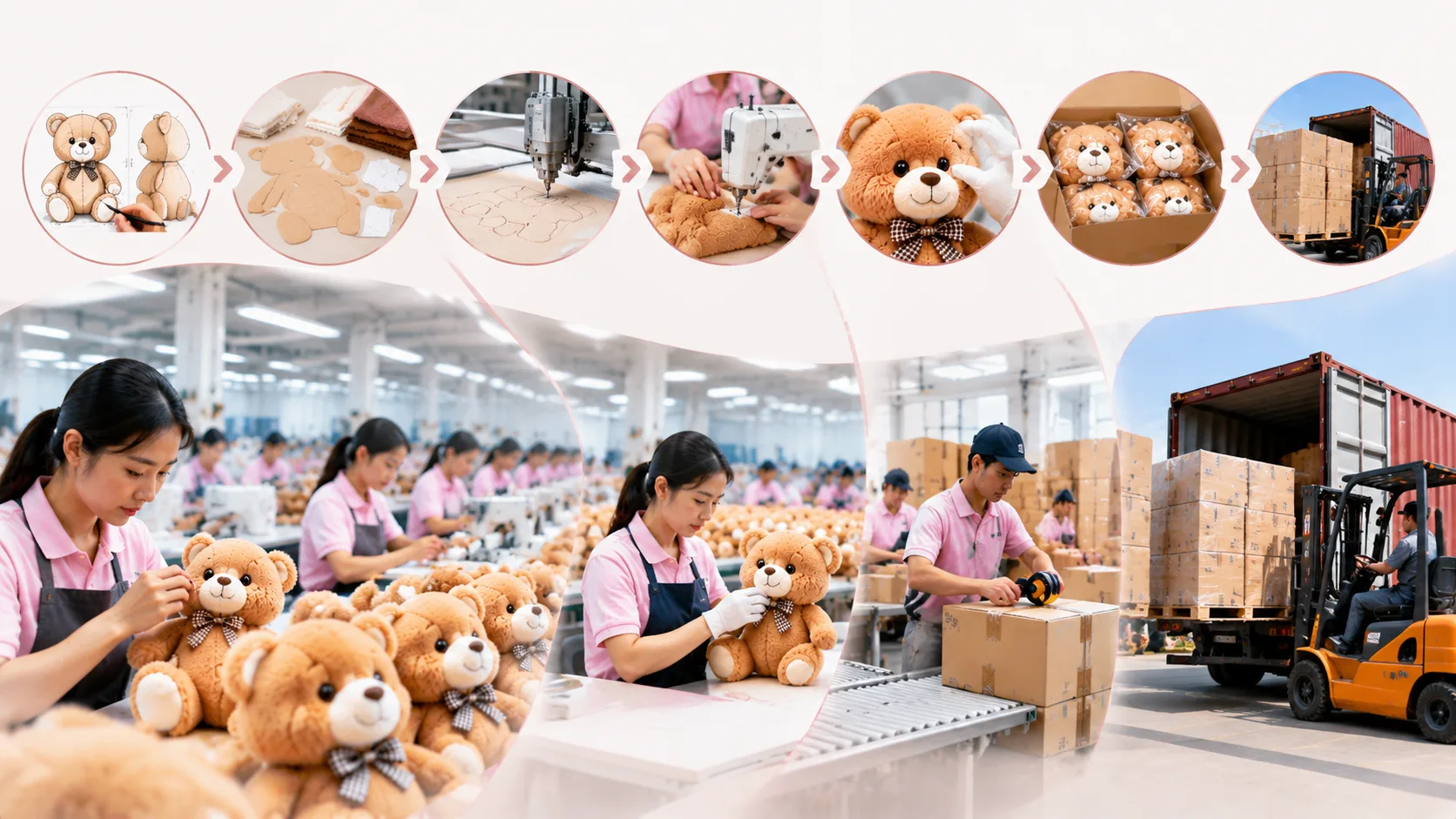
Translating artistic character IP into compliant, commercial-grade soft goods requires systematic engineering discipline. At BIUBIU TOY, every OEM production cycle follows a validated seven-stage manufacturing roadmap. By integrating early Design for Manufacturability (DFM) audits with strict milestone sign-offs, we eliminate assembly bottlenecks, safeguard physical brand fidelity, and ensure predictable production lead times across our turnkey products for brand owners, licensing agencies, and retail distributors worldwide.
Non-Negotiable Quality Baseline: The Golden Sample Sign-Off Lock
To protect buyers against dimensional drift, unexpected color variations, and silhouette deviations, BIUBIU TOY enforces an absolute manufacturing redline: high-speed fabric cutting and mass sewing never commence until your technical team formally reviews, tests, and signs off on the physical Pre-Production Golden Sample. This sealed benchmark establishes the definitive quality baseline across the entire bulk run.
Design Input & DFM Feasibility Audit
Our pattern engineers deconstruct your 2D character turnarounds, orthographic artwork, and Pantone targets. We evaluate structural stress zones, pattern split viability, minimum radius thresholds, and component attachment points to resolve manufacturing hurdles before physical sampling starts.
Pattern Engineering & Prototype Sampling
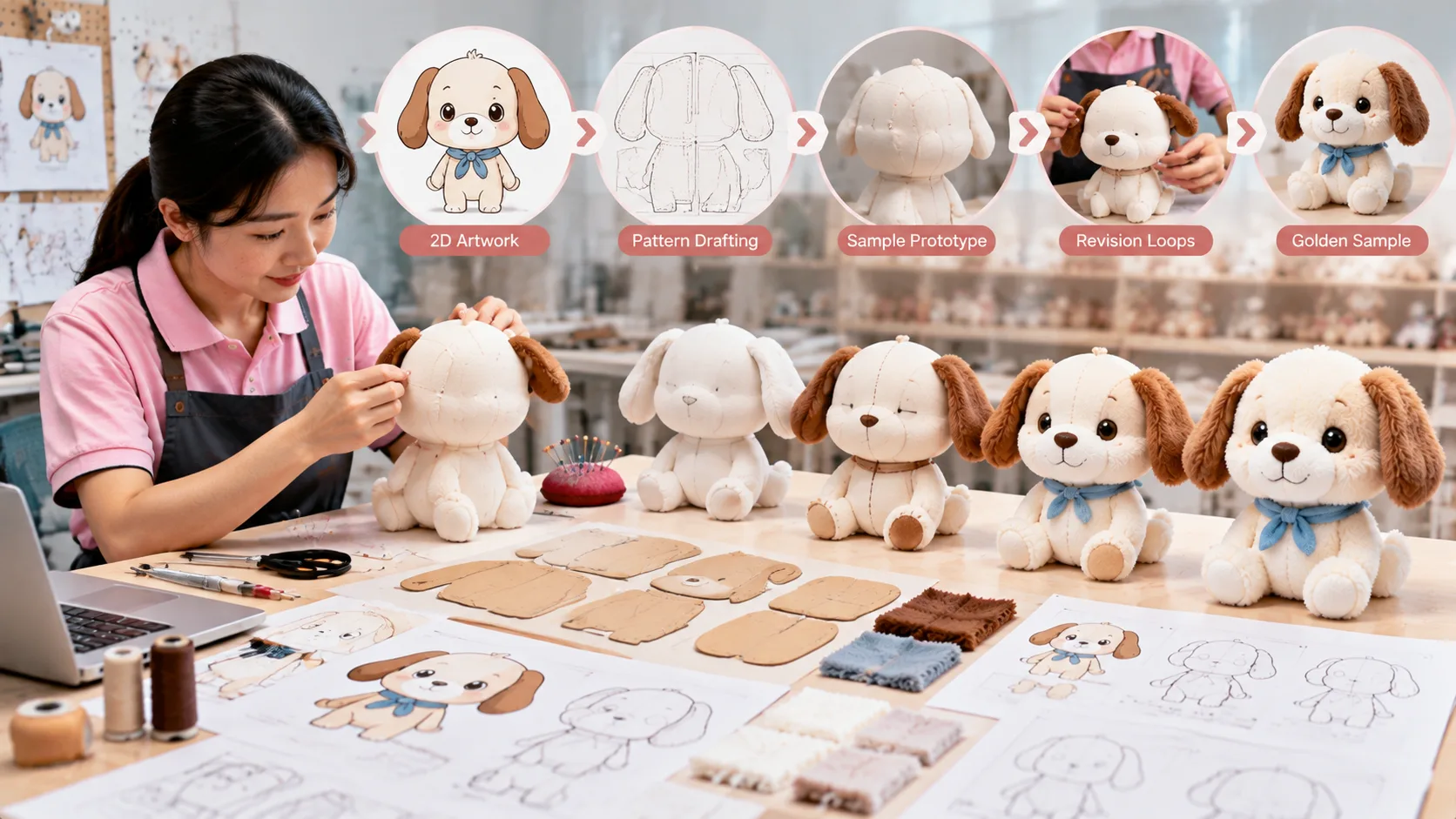
Master patternmakers translate digital files into calibrated paper patterns, stitching a raw muslin mock-up to verify volume, balance, and seam curvature. Once validated, our studio tailors a full-color prototype featuring custom-dyed pile fabrics and digitized embroidery tests for precision custom character plush projects.
Client Review & Golden Sample Calibration
The client team reviews the physical prototype against a standardized evaluation matrix. Our sample room refines facial embroidery angles, fabric nap orientation, stuffing density, and internal plastic armature positioning until the design achieves complete, verified alignment.
Raw Material Procurement & Batch Testing
Certified textile lots—including custom-milled crystal super-soft velvet, minky velboa, and post-consumer rPET yarns—arrive from audited dye houses. All fabrics, safety eyes, plastic joints, and polyester fibers undergo strict chemical checks for lead, phthalates, and flammability.
Automated CNC Laser Cutting & Embroidery
Multi-ply CNC laser cutting stations slice production fabric stacks within ±0.5mm tolerances while micro-fusing raw textile edges against fraying. Cut pattern bundles transfer directly to multi-head computerized Tajima embroidery machines and high-resolution heat transfer presses.
Sewing Assembly, Stuffing & Metal Detection
Specialized sewing operators join shell components using heavy-duty lockstitching. Pneumatic injectors feed virgin 7D/15D three-dimensional hollow PP fiber into each cavity before final hand-closing. Every single completed plush passes dual-channel metal detection calibrated to Ф0.8mm.
Custom Packaging, Export Pack-Out & Logistics
Finished units receive branded retail hang tags, compliant law labels, barcode stickers, and protective polybags before placement into reinforced double-wall corrugated cartons. Palletized loads are strap-secured and shrink-wrapped for international ocean, air, or multi-modal container transport.
Plush Toy Production Steps: Standard Operating Timelines and Quality Control Gates
| Production Phase | Engineering & Manufacturing Operation | Typical Production Lead Time | Quality Control Gate & Acceptance Criteria |
|---|---|---|---|
| 01. DFM Analysis | 3D Pattern Unfolding, Seam Stress Mapping & Feasibility Audit | 1–3 Business Days | Digital Geometry Clearance & Seam Verification |
| 02. Initial Prototyping | Muslin Volume Shell & First Full-Color Physical Build | 7–10 Business Days | Dimensional Silhouette & Facial Proportions Check |
| 03. Golden Sample Lock | Client Calibration, Embroidery Tuning & Master Sealing | Client Turnaround Dependent | 100% Signed Physical Approval Lockout |
| 04. Material Inbound QC | Dye Lot Color Matching, Component Influx & Safety Screening | 10–14 Business Days | ASTM F963 / EN71-3 Heavy Metals & Azo Dye Clearance |
| 05. Automated Cutting | Automated CNC Laser Cutting & High-Density Embroidery | Concurrent with Batch Scheduling | ±0.5mm Panel Tolerance & Heat-Sealed Edge Finish |
| 06. Line Assembly & Stuffing | Precision Seam Stitching, Hollow Fiber Stuffing & Metal Check | 15–20 Business Days | ≥90N Seam Pull Resistance & 0.8mm Ferrous Detection |
| 07. Retail Pack-Out | Hang Tag Affixing, Bagging, Master Carton Packing & Palletizing | 3–5 Business Days | AQL 2.5 / 4.0 Pre-Shipment Inspection Clearance |
Eliminate Supply Chain Surprises with Transparent Process Control
Understanding the complete plush toy manufacturing process gives enterprise buyers total control over their product delivery timelines, safety compliance, and profit margins. From initial 2D pattern unboxing to final palletized container loading, BIUBIU TOY combines traditional patternmaking craftsmanship with modern factory automation to guarantee flawless production runs.
- ✓ Comprehensive DFM engineering review included with every commercial custom plush toys manufacturing quote.
- ✓ Zero bulk cutting policy enforced until formal client sign-off on the physical Pre-Production Golden Sample.
- ✓ Dual-channel metal needle detection calibrated to detect ferrous contaminants down to Ф0.8mm across 100% of finished units.
Plush Toy Tech Pack and 2D-to-3D Engineering Design Standards
Converting creative character artwork into safety-certified custom plush toys requires industrial-grade manufacturing data. Flat visual illustrations do not calculate fabric nap direction, seam stretch tolerances, or volume expansion under fiberfill tension. Standardizing your plush toy tech pack eliminates engineering guesswork, shortens sampling turnarounds, and preserves anatomical fidelity through volume production.
At BIUBIU TOY, our master patternmakers leverage over 15 years of bench engineering experience. While our production team can develop comprehensive cut-and-sew patterns directly from an early conceptual illustration, submitting production-ready tech packs expedites design for manufacturability (DFM) reviews and secures first-round Golden Sample sign-offs for custom stuffed animals.
Non-Viable Production Inputs
- Single Dynamic 3/4 Poses: Perspective sketches hide dart geometry, rear seam alignments, and limb insertion angles, forcing technicians to approximate 3D volume.
- Uncalibrated RGB Color Values: Monitor-generated digital hex codes shift across variable mill lighting, leading to mismatched textile dye lots and embroidery thread divergence.
- Unspecified Dimensional Proportions: Artwork missing explicit sitting versus standing height references causes misjudged polyfill firmness, weight balance, and center-of-gravity failure.
- Ambiguous Surface Finishes: Unclear callouts between satin stitch embroidery, appliqué panels, or heat transfer film cause unexpected cosmetic variance and tooling cost overruns.
Qualified Production Tech Pack
Orthographic Projections
Orthogonal front, back, and true profile elevations drawn to 1:1 scale, including flat break-out schematics for complex ears, wings, tails, and modular accessories.
Pantone PMS Color System
Standardized Pantone Solid Coated (PMS C) formulas assigned to base pile fabrics, felt appliqués, and high-tenacity embroidery threading to ensure batch uniformity.
Anatomical & Hardware Callouts
Explicit height, width, and circumference dimensions in millimeters, coupled with placement coordinates for safety squeakers, rattle boxes, or bendable internal wire armatures.
Decorative Application Mapping
Layered artwork isolating tatami embroidery stitch lines, laser-cut appliqué boundaries, and silk-screened or heat-sublimated graphics with defined seam allowances.
Engineering Execution Blueprint for 2D to 3D Plush Translation
Translating 2D character art into dimensional custom character plush goods requires calculating fabric yield and radial contraction once fiberfill reaches full internal volume. Providing clear technical guidelines allows BIUBIU TOY engineers to map pattern panels, optimize seam layout, and construct robust prototypes that withstand international pull-force testing.
Three-View Projections
Provide true orthogonal front, side, and rear vector profiles. Complex character forms require flat pattern breakouts for asymmetrical appendages to establish seam connection lines.
Color Standardization
Specify Pantone PMS codes for all fabric panels, embroidery fills, and trim elements. Calibrated references prevent color variation between custom textile dye lots and bulk thread runs.
Structural Callouts
Define standing and seated heights in metric units, specifying baseline parting lines, internal skeleton hinges, and non-toxic polyethylene pellet pouches for base posture balance.
Decorative Methods
Differentiate fine facial contouring for computerized tatami embroidery from gradients or micro-textures suited for rotary screen printing or thermal sublimation transfer.
Production Tech Pack Self-Check Checklist
Verify that your engineering documentation includes these core criteria before requesting prototype sampling and tooling evaluation.
Vector Artwork Formats
Vector files in native AI, EPS, or layered PDF formats with converted outlines and segregated functional artwork layers.
Scale Ratios & Tolerances
True 1:1 manufacturing scale with dimension scale callouts denoting finished standing height, seated profile, and seam allowances.
Material Specification Memo
Detailed fabric allocations, specifying crystal super-soft velvet, sherpa fleece, or minky plush, paired with pile heights from 1.5mm to 45mm.
Age Grading & Safety Classification
Target demographic specification (0+ infant grade vs. 14+ collector item) dictating child-safe embroidered eyes or lock-washer plastic hardware.
Internal Structural Architecture
Defined positions for food-grade PE weight pellets, wire armatures, noise inserts, or battery-operated electronic IC modules.
Regulatory Label Positioning
Seam-insert coordinates for mandatory CPSIA tracking labels, CE/UKCA compliance ribbons, and custom woven branded care tags.
Core Plush Toy Fabrics, Tactile Textures, and Eco-Friendly Stuffing Guide
Tactile quality directly drives consumer emotional connection and commercial sell-through. Choosing the right plush toy fabrics, fiber deniers, and internal stuffing systems establishes aesthetic fidelity, structural resilience, wash durability, and regulatory toy safety compliance for premium custom plush toys. At BIUBIU TOY, every inbound textile lot adheres strictly to OEKO-TEX Standard 100 non-toxic chemical parameters, backed by comprehensive batch testing for seam tensile integrity, colorfastness, and abrasion resistance.
Commercial-Grade Textile Library for Scaled Custom Plush Manufacturing
Pile depth, warp knit density, and yarn composition define the physical character of finished plush figures. Balancing exterior surface softness with structural seam strength prevents stitch slippage during high-pressure fiber blowing and ensures long-term seam stability across international distribution and home laundering cycles.
Ultra-short micro-cut pile with zero fiber shedding. Engineered for anime collectibles, detailed custom character plush, and high-precision computerized surface embroidery.
Silky microfiber fleece featuring four-way controlled elasticity. Hypoallergenic, pill-resistant, and the industry gold standard for infant plush items and baby security blankets.
Textured nubby loops that recreate traditional heirloom teddy bear finishes. Provides vintage visual warmth, dense structural body, and premium tactile grip for classic custom stuffed animals.
High-pile dimensional plush engineered for hyper-realistic wildlife reproductions, monster tails, character hair pieces, and designer art-toy accent trims.
Eco-Friendly Recycled rPET Plush Textiles
BIUBIU TOY sources certified Global Recycled Standard (GRS) fabrics processed from post-consumer recycled plastic bottles. These circular yarns provide full chain-of-custody documentation, lowering carbon footprints without compromising ultra-soft tactile quality or color saturation.
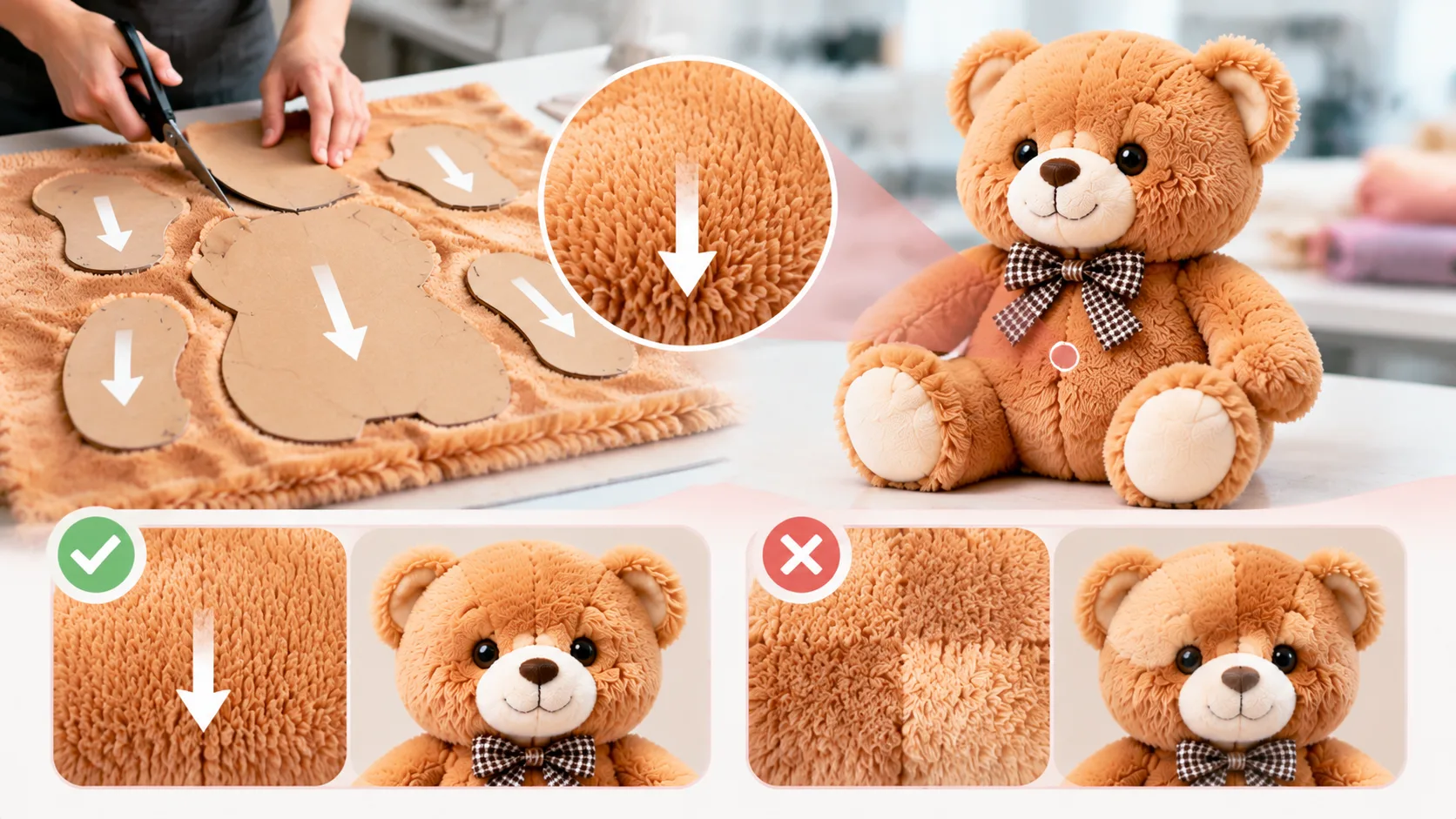
Engineering Protocol: Nap Orientation
Cutting dies must be oriented with fabric nap flowing downward across matching panels to prevent directional light refraction and tonal shade differences under retail lighting.
| Fabric Classification | Pile Height | Weight (GSM) | Laundering Performance | Recommended Application |
|---|---|---|---|---|
| Crystal Super Soft | 1.5 – 2.5 mm | 180 – 260 GSM | High Durability (Machine Wash Warm) | Anime Figurines, Corporate Mascots, Gaming IPs |
| Premium Minky (Smooth / Embossed) | 2.5 – 4.5 mm | 240 – 320 GSM | Superior (Infant Sanitization Cycles) | Infant Rattles, Comfort Blankets, Nursery Plush |
| Sherpa / Bouclé Fleece | 8.0 – 14.0 mm | 280 – 400 GSM | Moderate (Gentle Wash Air Dry) | Heritage Bears, Nordic Dolls, Textured Accents |
| Faux Fur / PV Long Pile | 18.0 – 50.0 mm | 380 – 620 GSM | Delicate Surface Clean Only | Collector Animals, Fantasy Creatures, Collars & Tails |
International Toy Safety Compliance, Physical Testing Protocols, and Customs Clearance
Cross-border supply chains for custom plush toys require uncompromising adherence to destination-market consumer safety mandates. BIUBIU TOY integrates rigorous pre-production Design for Manufacturability (DFM) reviews with ISO 17025 accredited laboratory testing to eliminate the risk of port detentions, customs seizures, retailer rejections, and commercial recalls across North America, the European Union, the United Kingdom, and Asia-Pacific markets.
North American Standards (CPSC & ASTM)
Statutory compliance frameworks enforced by the U.S. Consumer Product Safety Commission and Health Canada for direct entry and major retail stocking.
- ASTM F963 Plush Compliance: Mandatory physical, mechanical, flammability, and toxicological assays covering 8 soluble heavy elements.
- CPSIA Chemical Ceilings: Total accessible lead content under 100 ppm, with regulated phthalate plasticizers restricted below 0.1% (1,000 ppm).
- Statutory Tracking Labels: Permanent sewn-in labels recording manufacturing batch run, production date, facility source, and traceability codes.
- Children's Product Certificate (CPC): Formal legal documentation issued through accredited laboratory pass test reports prior to container dispatch.
European & UK Market Conformity (CE & UKCA)
Harmonized safety directives, technical dossier readiness, and migration safety thresholds required under EU Toy Safety Directive 2009/48/EC.
- EN71-1 Mechanical & Physical Safety: Rigorous impact, drop, torque, and tensile evaluations to eliminate sharp points and detachment hazards.
- EN71-2 Surface Flammability: Rate-of-flame-spread testing ensuring textile pile burn velocity remains well below the statutory 30 mm/s limit.
- EN71-3 Heavy Metal Migration: Trace element screening analyzing zero synthetic gastric fluid extraction across 19 monitored chemical compounds.
- CE & UKCA Affixation: Legally compliant logo geometry, importer identification, and Declaration of Conformity (DoC) preparation.
In-Factory Physical Stress & Screening
BIUBIU TOY runs 100% inline non-destructive screening alongside randomized destructive stress assays to maintain flawless batch uniformity.
- Seam Tensile Strength Testing: Main structural joining seams tested under continuous >21.0 lbs (90 N) tensile load for 10 full seconds.
- Small Parts Torque & Pull Test: Rigid safety eyes, noses, and hardware subjected to 0.45 Nm torque and 15 lbs pull to eliminate choking risks.
- Dual-Channel Metal Needle Detection: High-sensitivity conveyer scanning calibrated to 0.8 mm–1.0 mm ferrous particles on every single item.
- Clean Filling Validation: 100% virgin conjugated 7D/15D polyester fiber, free from unwashed recycled impurities, odors, and contaminants.
Manufacturing Quality Verification Matrix: Regulatory Limits vs. Factory Standards
Direct engineering comparison showing mandatory international baseline limits versus BIUBIU TOY manufacturing tolerances.
| Inspection Property | Testing Directive | Legal Minimum Threshold | BIUBIU TOY Standard | Verification Output |
|---|---|---|---|---|
| Seam Integrity & Tensile Hold | 16 CFR 1500.51-53 / EN71-1 | 15.0 lbs (66.7 N) / 10s continuous hold | ≥ 21.0 lbs (93.4 N) / 10s continuous hold | Zero stitch slippage or rupture |
| Small Parts Retention (Choking Hazard) | 16 CFR 1501 / ASTM F963 / ISO 8124 | Parts must not fit standard small-parts cylinder | Double-washer thermal lock or heavy embroidery | Certified safe for Ages 0+ and 3+ |
| Pile Surface Flammability | 16 CFR 1500.44 / EN71-2 Clause 4.5 | Burn rate < 0.1 in/sec (2.5 mm/sec) | Self-extinguishing synthetic fibers (< 1.0 mm/sec) | Pass without surface flashover |
| Heavy Element Extraction & Phthalates | ASTM F963-17 / EN71-3 / CPSIA Section 108 | Total Lead < 90 ppm, Cadmium < 75 ppm | OEKO-TEX 100 Standard certified non-toxic dyes | Non-detectable chemical residue |
| Foreign Metallic Particle Detection | ICTI Ethical Toy Program / Global Retailer Specs | 1.2 mm ferrous particle threshold | 0.8 mm continuous dual-channel sensitivity | 100% individual piece inline verification |
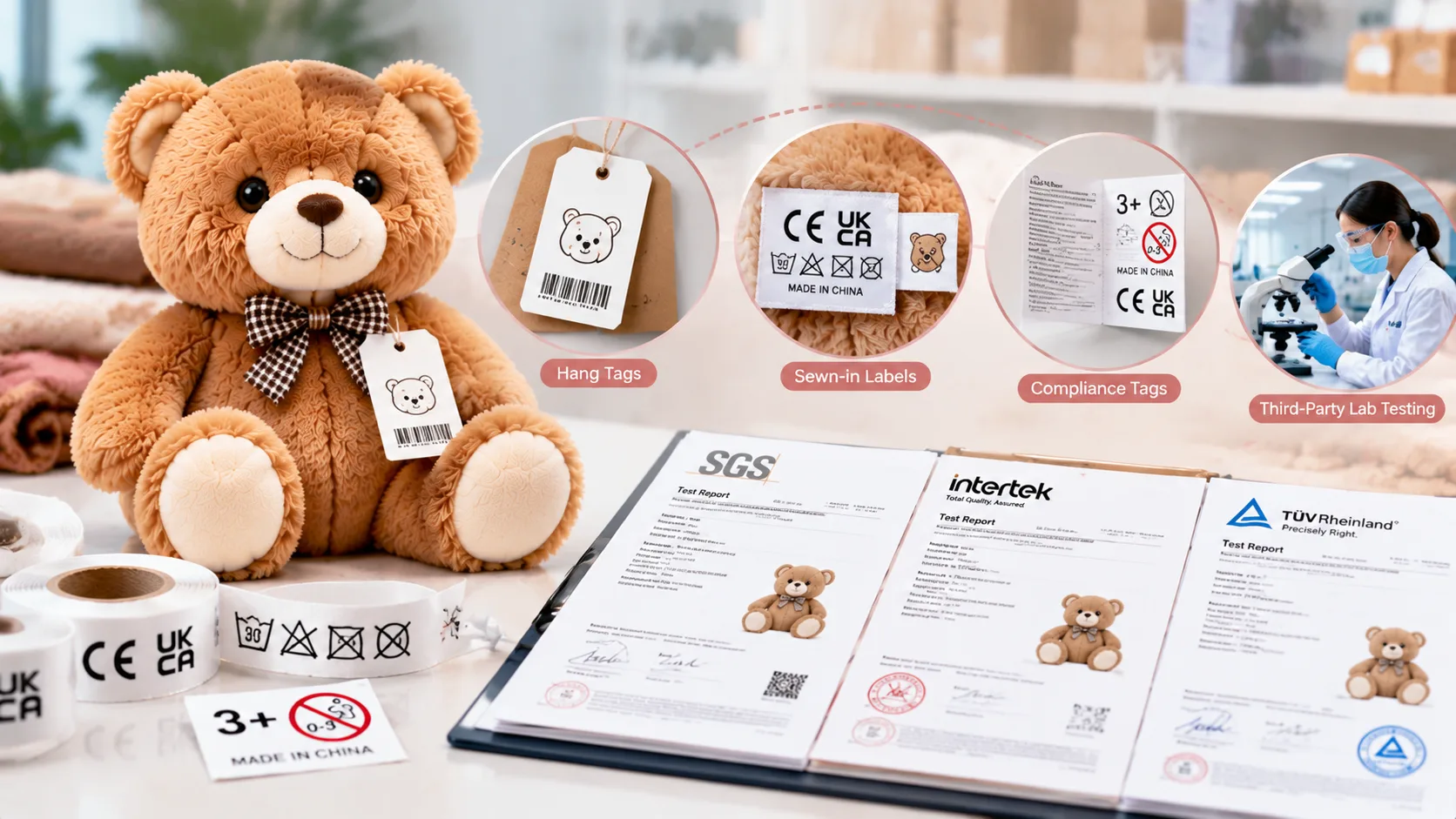
Statutory Tracking Labels, Law Tags, and Laboratory Partnerships
Regulatory inspections at international entry ports frequently target labeling deficiencies rather than physical structural flaws. Under CPSIA Section 103, Canadian toy regulations, and EU requirements, all commercially distributed plush merchandise—including retail-ready custom stuffed animals—must feature indelible tracking marks. Our production engineers build compliant woven labels and sew-in law tags detailing batch lot codes, production dates, manufacturing site markers, fiber content percentages, and care designations in statutory typography.
Through long-standing working relationships with globally accredited third-party laboratories—including SGS, TÜV Rheinland, and Intertek—BIUBIU TOY coordinates end-to-end pilot testing and mass lot compliance certifications across all manufactured products. Testing certificates are issued under your brand name, enabling seamless acceptance by customs officers, enterprise buyers, Amazon FBA, and major global mass retailers.
Custom Plush Prototype Development, Pattern Deconstruction, and Revision Loops
Transforming flat 2D character artwork into balanced, production-ready 3D custom plush toys requires precision pattern drafting and methodical physical testing. At BIUBIU TOY, our master patternmakers utilize structured iteration cycles to control sampling timelines, resolve dimensional silhouettes, and finalize the Pre-Production Golden Sample needed for streamlined mass manufacturing.
Three-Stage Prototyping Roadmap
Standard 15-Day CycleMuslin Pattern Mockup
Days 3–5Preliminary unbleached cotton calico shells confirm volume, curvature curves, and core proportions before cutting custom dye-lot fabrics.
Full-Color First Prototype
Days 7–10Fully sewn sample utilizing specified production fabrics, embroidery stitches, and direct printing to assess character likeness, pile nap, and color fidelity.
Pre-Production Golden Sample
Final Sign-OffThe counter-sample benchmark fully trimmed with retail hang tags, sewn-in law labels, and packaging. Production lines reference this sealed master during assembly.
100% Sampling Fee Credit Policy
Initial sample development costs are fully credited back toward commercial production invoices once minimum wholesale volume thresholds (starting at 1,000 units) are confirmed.
First Sample Unboxing Evaluation Matrix
Reviewing physical samples systematically expedites turnarounds. Our engineering floor implements modifications rapidly when teams provide quantifiable dimensions rather than subjective impressions.
Anatomical Proportions & Polyfill Firmness
Evaluate 3D facial contours, limb connection angles, and overall torso firmness. Determine whether polyfill stuffing requires higher pack density for structure or softer stuffing for squeeze resilience.
Facial Embroidery Registration & Catchlight Alignment
Examine pupil positions, catchlight highlights, and facial feature symmetry. Check that stitch tension maintains crisp line boundaries without puckering surrounding velboa or minky fabric.
Fabric Nap Direction Uniformity
Ensure the pile run flows smoothly downward from crown to base across all pieced fabric panels. Misaligned pile grains disrupt light refraction, color consistency, and hand feel across joins.
Center of Gravity & Unsupported Posture
Confirm that sitting or standing plush sit upright without tipping on horizontal shelves. When engineering specialized items like custom stuffed animals, review inner non-toxic PE/PP plastic pellet pouches to ensure proper counterweight placement.
Standardized Revision Protocol
Production Best PracticeTo prevent scattered revision requests that derail manufacturing schedules, BIUBIU TOY maintains a consolidated engineering protocol:
- • Consolidated Redline Markups: Consolidate modification notes into one marked-up document covering front, side, and rear angles with metric measurements in millimeters or centimeters.
- • Remote 360-Degree Macro Video: For intricate, asymmetrical designs such as multi-layered custom character plush, our team prepares 4K rotating video walkthroughs and macro closeups prior to international dispatch to streamline remote sign-offs.
- • Golden Sample Lock: Cutting mass production yardage starts only after physical Golden Samples receive signed approvals, safeguarding batch-to-batch consistency.
Ready to Develop Your Custom Plush Prototype?
Share your character artwork and specifications. Our engineering team will review production feasibility and provide sampling guidance within 24 hours.
Tiered MOQs, Unit Cost Actuarial Model, and Production Scheduling
Commercial soft toy manufacturing requires a transparent actuarial breakdown between design complexity, bill of materials (BOM), and order volume. At BIUBIU TOY, we demystify factory line quoting by giving brand directors, licensing executives, and procurement teams direct insight into pattern yields, sewing labor allowances, and tooling amortization for all custom plush toys. Calculating your custom plush MOQ parameters and evaluating baseline plush toy manufacturing cost variables early prevents capital misallocation and keeps wholesale product rollouts on schedule.
Developed Size & Pile Height
Textile usage scales cubically rather than linearly once drafted in three dimensions. A 10cm keychain custom mascot plush utilizes minimal fabric acreage, whereas a 60cm sitting plush demands extensive raw meterage and heavier polyester fiberfill cores. In addition, long-pile faux furs (15mm to 50mm) require unidirectional cutting layouts to maintain consistent nap direction, reducing laser-cutter nesting efficiency compared to omnidirectional short-pile crystal velboa.
Pattern Piece Count & Seams
Total piece count directly drives manual sewing bench cycles. A streamlined 8-piece plush sphere stitches together in minutes. Conversely, an intricate custom character plush IP requiring 25 to 45 individual cut panels, underarm gussets, inset facial muzzle seams, and articulated digits multiplies operator handling time. Turning intricate extremities right-side out, reinforcing joint seams, and executing clean ladder hand-closures directly dictate factory assembly labor costs.
Embroidery & Surface Details
Facial expressions, brand crests, and graphic markings require computerized multi-head embroidery. Industrial machinery rates calculate strictly by stitch density and thread color changes. Heavy tatami fill areas, metallic threads, or glow-in-the-dark yarns increase head run time and bobbin maintenance. For large decorative shapes, applying satin-bordered fabric appliqué patches rather than full thread fills cuts machine time significantly while preserving premium texture.
Packaging Architecture & Freight
Packaging selection impacts secondary assembly labor and landed transpacific freight efficiency. Standard polybags with suffocation warnings preserve maximum carton density. In contrast, 400gsm rigid window boxes, blind boxes, or collapsible magnetic presentation cases require manual structural folding, custom blister tray inserts, and significantly higher cubic displacement, noticeably impacting container freight economics on bulk ocean routes.
Interactive Production Volume and Lead Time Schedule
Select a commercial volume tier below to view benchmark turnaround times, material sourcing channels, and milestone requirements.
Starter Run: Art Toys, Capsule Drops & Event Merchandising
Engineered for independent IP creators, convention merchandise lines, and brand test pilots. This tier draws from our extensive inventory of pre-certified, in-stock textiles, bypassing raw mill dyeing minimums while ensuring retail-grade compliance and hand feel.
- ✓ Tooling Amortization: Laser-cutting steel dies and digital embroidery setup absorbed over practical starter runs.
- ✓ Stock Fabric Library: Instant access to over 300 in-stock, OEKO-TEX Standard 100 crystal velboa and minky colorways.
- ✓ Full QA Standard: End-of-line double needle detection and seam pull verification applied to every unit.
Cost Engineering Advice
To maximize margin at 500 to 1,000 pieces, keep individual embroidery zones under 8,500 stitches and choose verified warehouse stock fabrics to avoid mill surcharge penalties.
Plush Toy Manufacturing Cost Breakdown Reference
Typical expenditure allocations across standard commercial plush production lines. Understanding these ratios enables engineering teams to execute effective Design for Manufacturability (DFM) adjustments before cutting production fabric.
| Cost Driver Component | Typical Cost Share (%) | Primary Influencing Parameters | DFM Optimization Strategy |
|---|---|---|---|
| Shell Fabric & Internal Liners | 30% – 40% | Pile height, fabric weight (GSM), virgin vs. GRS-certified rPET, nesting yield efficiency | Adjust irregular panel contours to streamline automated laser nesting and reduce cutting room scrap |
| Machine Sewing & Hand Assembly | 25% – 35% | Linear seam inches, tight curve articulation, gussets, manual final port closures | Consolidate redundant minor panel darts into unified silhouette cuts without sacrificing character shape |
| Polyfill Stuffing & Structural Weights | 10% – 15% | 7D/15D conjugated hollow siliconized fiberfill, high-density PE weighting pellets, internal frames | Calibrate fiberfill density and concentrate pellet pouches in the base section for self-standing balance |
| Embroidery & Graphic Embellishments | 8% – 12% | Total stitch count, thread breaks, metallic/specialty yarns, heat-transfer details | Utilize die-cut felt or velboa appliqué patches for solid colored areas rather than high-density tatami stitches |
| Packaging, Quality Assurance & Testing | 7% – 15% | Retail display boxes, FSC hang tags, sewn-in tracking labels, lab safety certifications | Standardize export master carton dimensions to maximize freight container cubic capacity and reduce shipping costs |
Transparent Factory-Direct Procurement with BIUBIU TOY
Through primary textile mill integrations, automated sewing cell allocations, and intelligent scheduling systems, BIUBIU TOY eliminates unnecessary trading markups while upholding stringent international quality and safety benchmarks. Our engineering staff provides line-item DFM cost evaluations and lead time timelines within 24 business hours.
Commercial Packaging, Statutory Labeling & Brand Enablement
BIUBIU TOY engineers shelf-ready packaging, custom trims, and cross-border regulatory labels concurrently with your custom plush toys prototypes—eliminating secondary handling and accelerating global time-to-market.
Custom Hang Tags
Engineered on 350gsm to 700gsm specialty art boards with custom die-cut contours, tactile coatings, and security features.
- Multi-tier spot UV and velvet soft-touch laminates
- Precision metallic foil stamping and blind debossing
- Serialized anti-counterfeiting holographic foil seals
Woven & Law Labels
Permanent tracking trims formatted to strict North American Uniform Law standards and European CE marking directives.
- High-density damask and soft edge satin weave tags
- Compliant US (PA/OH/CA) sterilizer law label templates
- Thermal-set wash-care symbols and multilingual warnings
Eco Packaging
Circularity-driven product packaging that protects plush textures from humidity and dirt while fulfilling corporate ESG mandates.
- Certified compostable PLA plant-resin polybags
- 100% GRS post-consumer recycled rPET bags
- Frosted reusable EVA zip pouches with die-cut handles
Display & Blind Boxes
Rigid, high-caliper retail packaging built for blind-box collectible assortments, supermarket endcaps, and fast checkout placement.
- 400gsm CCNB four-color laminated blind boxes
- Anti-scratch transparent PET showcase window cartons
- Heavy-duty corrugated countertop PDQ display trays
Synchronized Prototyping & Zero-Lag Deployment
Structural dielines, packaging proofs, and barcode verifications are executed directly alongside custom character plush revisions. By synchronizing trim production with assembly schedules, your finished production run emerges fully tagged, boxed, and ready for immediate retail stocking.
Box compression strength modeling and drop shock testing protect retail-ready units in transit.
Strict ISO/IEC 15416 print-quality verification ensures 100% scan success across global POS terminals.
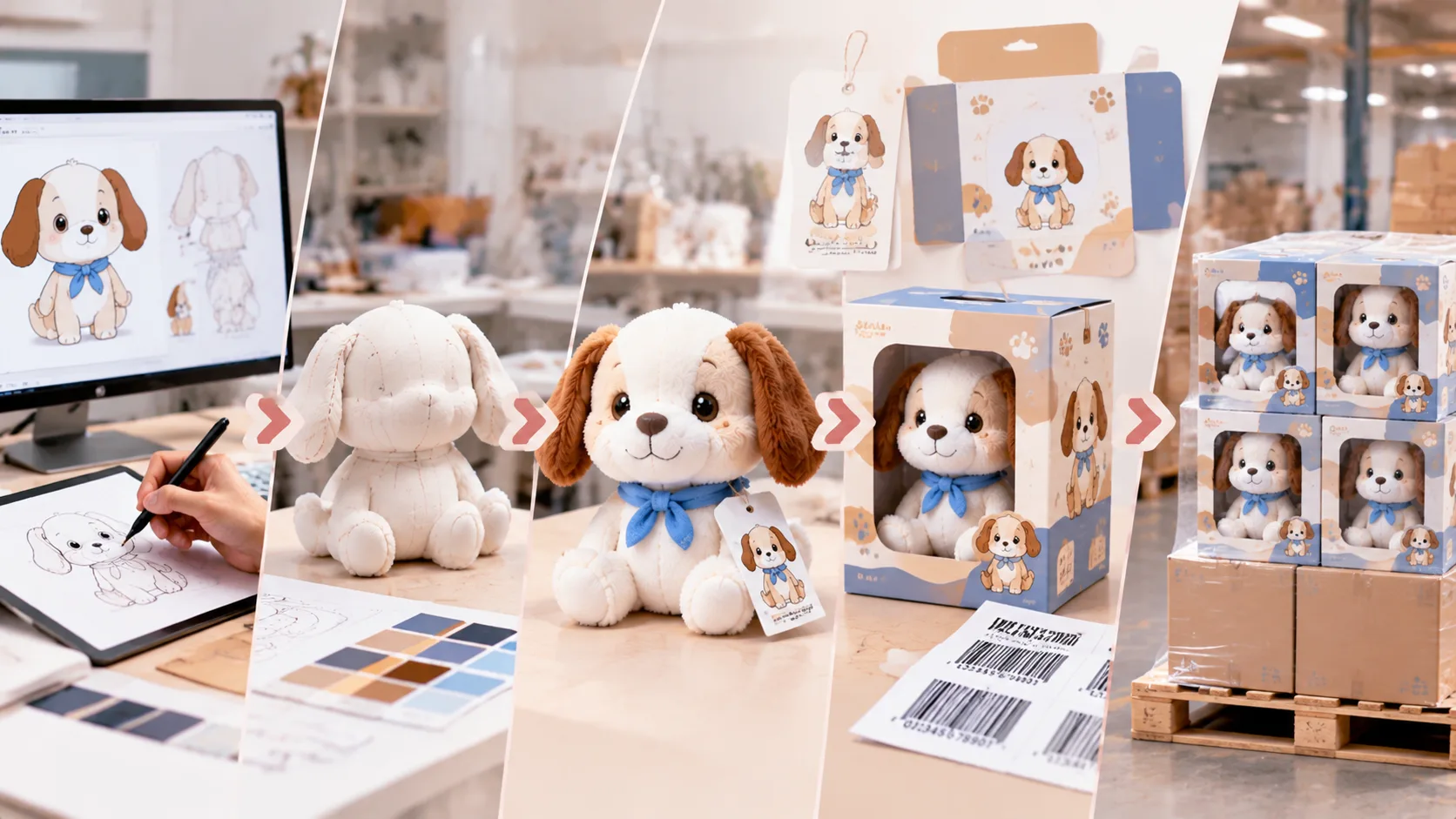
BIUBIU TOY packaging certifications and retail import standards:
B2B Plush Manufacturing FAQ: Production, IP & Quality SLAs
Commercial procurement directors, IP licensors, and gaming merchandise executives face critical risk decisions when scaling character concepts into retail inventory. Discover how our engineering standards, airtight NDA protections, milestone QA protocols, and volume credit frameworks empower you to turn design into plush toy collections with a verified plush toy OEM manufacturer.
Bilateral Binding NDA
Enforceable intellectual property covenants executed prior to CAD file intake, supported by air-gapped data servers.
100% Sampling Fee Rebate
Full prototyping, pattern drafting, and revision costs are credited directly against your mass production bulk invoice.
ANSI / ASQ AQL 2.5 / 4.0
Industrial lot sampling backed by 100% two-stage conveyorized needle detection calibrated down to 0.8mm ferrous particles.
Over 92% Client Retention
Backed by decades of export excellence, delivering fully compliant custom plush toys across US and European retail channels.
Rigorous IP governance forms the foundation of our OEM partnerships. Before accepting concept sketches, tech packs, or 3D turnaround files, BIUBIU TOY enters into an enforceable bilateral Non-Disclosure Agreement (NDA) structured under US and international intellectual property law. We assign your project an anonymous internal stock keeping code so your registered trademark and brand name never appear on shop floor routing slips.
Our pattern engineering rooms, automated CNC cutting beds, and digital embroidery suites operate under strict badge-access security. Personal smartphones, cameras, and external storage devices are strictly prohibited within prototyping laboratories and pre-production lines. Digital vector assets and sewing path files are hosted in permission-controlled, encrypted local servers with automated access logging.
We uphold an absolute zero-leak guarantee: unreleased client prototypes are never displayed at industry trade fairs, showcased in public marketing decks, or sold through secondary liquidations. Surplus units and test cuttings are documented and incinerated under certified internal chain-of-custody protocols.
OEM Procurement SLA and Risk Governance Benchmark
Comparing BIUBIU TOY contract engineering standards against unregulated commodity workshops.
| Procurement Parameter | BIUBIU TOY Industrial Guarantee | Unregulated Workshop Standard |
|---|---|---|
| IP Protection Legal Rigor | Pre-intake Bilateral NDA, encrypted CAD vaults, no external marketing use | No formal NDA; samples frequently showcased on public open marketplaces |
| Safety & Metal Needle Testing | 100% two-stage conveyorized needle detector (0.8mm ferrous calibration) | Manual hand-held wand checks or random batch sampling only |
| Physical Seam Strength | Validated >21 lbs (90 N) mechanical pull tension for 10 continuous seconds | Subjective hand pull inspection without calibrated tensile dynamometers |
| Prototype Rebate Policy | 100% pattern fee offset against bulk orders meeting standard MOQ | Sampling fees retained as non-refundable workshop surcharge |
| International Compliance Support | ASTM F963, CPSIA CPC generation, EN71 1-3, CE/UKCA marking documentation | Client must manage lab submissions and regulatory tracking labels independently |
Require a bilateral NDA executed prior to file transmission or looking for specialized DFM guidance for custom stuffed animals? Connect directly with our plush toy OEM manufacturing engineers today.
Ready to Turn Your 2D Design into a Market-Ready Plush Toy?
Submit your concept sketches, Adobe Illustrator vector art, or production tech packs. As an experienced OEM manufacturer specializing in custom plush toys, our engineering team completes a full design for manufacturability (DFM) review and preliminary unit cost estimate within 24 business hours.
From boutique creators designing custom character plush to high-volume retail licensors scaling lines of custom stuffed animals, BIUBIU TOY provides the end-to-end plush toy manufacturing guide, certified testing compliance, and patternmaking precision needed to scale your IP smoothly.
Request a Factory Quote
Tell us about your project. Our team will review your requirements and get back to you.